regret’s this week’s worst hangover, a pain like fireworks
through mud, like trying to throw your face through your face
or the boiling veins in your eyeballs. Still, what we do
here’s the stuff of gods. The roots are also the cosmos.
October 29th 2021
Are you still watching? The screen going blank to save
itself, or cutting cold to a red-brick maze?
You can only live so long before you hurt,
at least, a fly, only long so long
before you’ve slept in every room of longing
’s curious house, which generates its corners
more the more you try to turn them. Sleep
mode overcomes me, haunted by the next episode,
my future queued in stacks like postcards sent
before untimely death (the only kind), arriving after
over what appears to be that “It”
that nobody won’t shut up about. Anyway,
if anyone’s still watching, I go blank
to save myself, let the autoplay ride.
October 28th 2021
You can learn a lot about yourself
by your relationship to rain, what
you use to interrupt it. Palm, tongue,
or jerrycan. Crown, rib, or eyeball.
Strychnine local waters lapping loosely
in the font begins the beachside funeral.
Over by the buffet, forcing meat
between my teeth, I bump into a guy
who says, as rain tattoos the sand, buddy,
you’ve gotta forget what death does to a face –
mouth folding like a shattering zeppelin,
eyes like an oval of sky fizzed with flame
then greyer than fog in front of rotten temples –
if you wanna continue to look at the living.
October 27th 2021
I bumped into another autumn morning. Ouch.
I admit it, I was looking over my shoulder
then over another shoulder, then over there
at where something has just vanished from the sky
like Poussin adding pigment to remove
a flock of pigeons from beyond a citadel,
painting, therefore, aftermath itself.
Like long-exposure prints of rivers, every
painting is a painting of an after,
the present moment streaming into history
behind the canvas like inks in fast water.
I run my throbbing head beneath the tap
and think, does ‘me’ begin at skin
or some other, further cloud.
October 26th 2021
Is a grounded group of birds a flock,
still, or is their recognition based
on leaving lakes behind? Is a toast
a prayer to drink, a prayer a toast to God?
I know as I sit here that somewhere there dies a boy
in a street, his mouth filling up with leaves.
I know when I leave here my blood will transform a cup
in the mouths of my friends. I know I’ll never know
quite how or when to say goodbye,
but hope it’s known, in general, that I wanted to.
Towards the end of vast and massy chains
I am, I think, responsible for dim
and spacious griefs. Forgive me. Cancel Christmas
if it helps, swap my soul (goodbye) for thine.
October 25th 2021
Open onto morning like a blister
– line removed for use in a different poem
The days like grains on grains don’t heap.
A moorhen’s summons calls us to the mornings
of our cells. A suburb of children with scoopnets
in fists disturb the throats of frogs. Frogs throw
their voice with a sound like wet glockenspiels.
Bernadette Mayer writes a duck
flies away / using circles. By
the end of this line, you’ll have a new memory
of wanting to feel the way you felt the day
you wore your first uniform for school.
By the end of this line, you’ll have a new
memory, a new memory of the previous
line. A kid throws crumb, then crumbs, then the whole
bagel at a duck, using circles to give the world flight.
October 24th 2021
The days like grains on grains don’t heap
– line removed for use in a different poem
Open onto morning like a blister,
biscuits of light covering either eye
like cucumbers in a cartoon spa, I turn to be
unable to see your blinded face for sun.
The mathematic edges of the calendar
solve into the number of how many towels
we can set to going dry on the bannister,
whether or not the cat’s saliva dropped
like chaos into my coffee, its pattern of heat
coiling into my palms.
If love is not
enough, perhaps it is that every day
we wipe away each other’s gunky sleep
from the ampoule-shaped ducts of our eyes,
then take it in turns to do the same for the cat.
October 23rd 2021
after RJCB
I
Because the poem can’t decide for us
if winter’s yet begun
because the future marshals us with gestures
learned before we’re born
because everything I’ve said could fit inside
an ampoule of ice of your spit
I
because “we are not in the same place”
because “the subject is unaware of our presence”
because I turned away before the clouds completely occluded
because I’m looking through between two windows to where I’m sat
because it might not happen only
because it already has
I
because the poem decides all this for us
you obviously have my permission to do this.
Note: the lines “we are not in the same place” and “the subject is unaware of our presence” were spoken by, I think, the popular Dutch artist Casper Faassen, a slick and polished Art Fair favourite who nevertheless summed up this idea nicely enough. The poem as a whole is a response to a better poem written by Rowland Bagnall.
October 22nd 2021
The things of winter lurch into your path.
Some branches paw agog the space that’s grown
an emptiness between them. Foxes sniff
the fibreglass on undersides of cars,
a knife of wind in either nostril, limbs
about to clutch into a scrabbled exit.
The air is only cooling, can’t quite get
cool. There aren’t the peals of bells beyond.
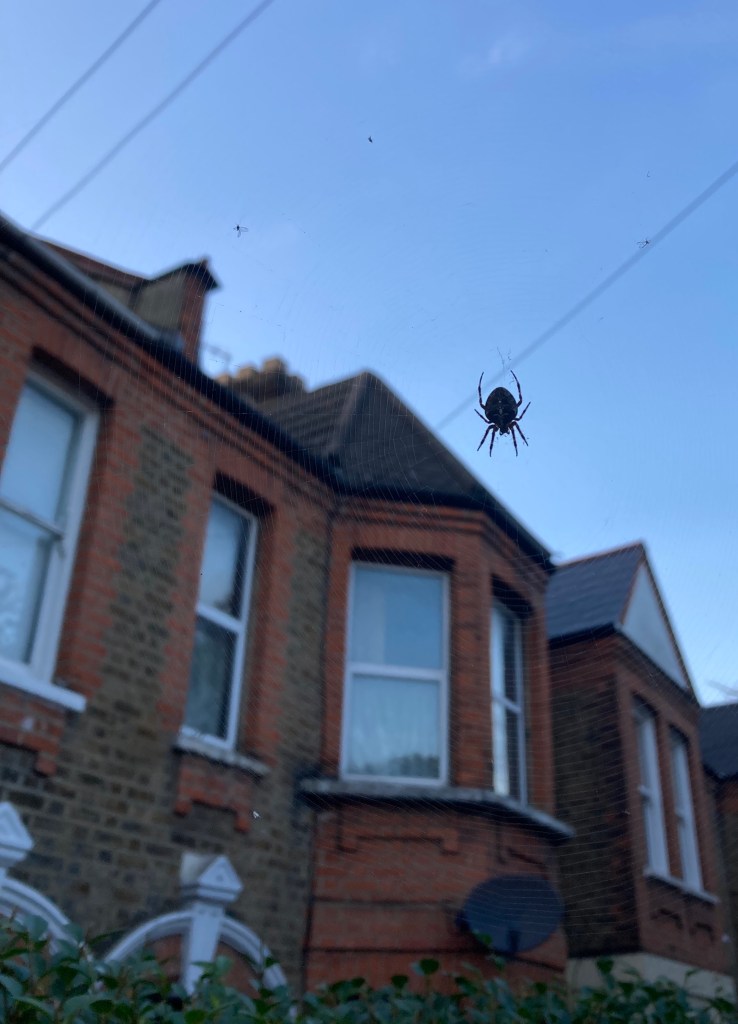
Again, I’m looking through a bay window
at the outside of a window set
into the same wall. To be clear,
the bay protrudes enough for me to see
back into the room in which I sit
ignoring the foxes, the lack of the sound of bells.
Antaeus Ad Astra: A Poem
back in 10 mins: jeff bezos waves “goodbye” to earth
15th century spacemen beating bezos at his own game (and inviting us along for the ride)
A few months ago, Jeff Bezos went to space. Sort of. The CEO of Amazon, richest man since Mansa Musa, and compulsive ten-gallon-cowboy-hat-wearer blasted himself off into (and beyond) the sky in a rocket which (as many have noted but which bears repeating) looked extremely like a massive cock.
10 minutes later, he was back again, having cusped beyond the Kármán line (the sketchily-defined boundary separating the upper atmosphere from outer space) for a couple of seconds, alongside his other crew members.
It seems you either buy into this mission or not. You’re either entirely on Team Bezos or you’re part of the carousel of dick-joke memes. Maybe something as baldly immense as The Cosmos defies nuance (to say nothing of someone so baldly and corruptedly rich as Bezos). But is there some other possible response to the new Joy Ride Space Race? What can we think about other than ‘wonder’ on the one hand and ‘willies’ on the other?
The wonder of space is twofold. It is, of course, the ‘Final Frontier’, a vacuum so total and terrifying that it draws us into itself. We have a compulsion towards the unknown, and nothing defines the unknown quite like space. But, perhaps even more potently, we’re drawn out into the abyss so that we can look back on ourselves. Its blackness is a mirror. Centuries before Bezos’ bell-ended rocket, outer space was imagined as a vantage point for self-searching. Dante, Chaucer, and many of their Classical precedents imagined upward ascents with the goal of looking back. Cicero’s famous passage relating the Dream of Scipio sees the Roman General carried up into the cosmos to look down on Carthage. Once there, he views its smallness and fragility with scorn.
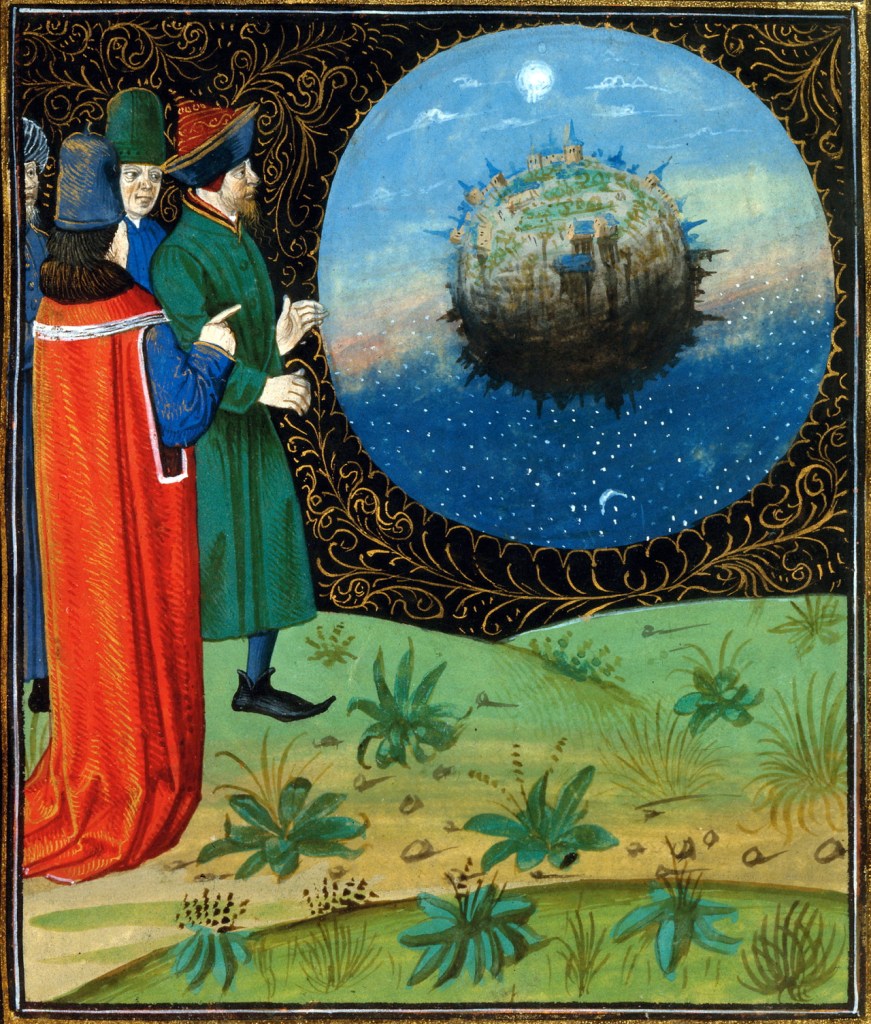
But let’s consider a more optimistic version of this trope. In Jean Corbichon’s 15th Century French translation of the 13th Century On the Properties of Things by Bartholomeus Anglicus, a very curious image appears (see above). Four men, scientists or philosophers, look through a porthole down onto the globe of the earth, deep in discussion. As an excellent video from Birkbeck, University of London, explains, this picture makes us “think about looking”, and think about ourselves.
Where this vision differs from Bezos’ is important. In the picture, our planet is spiked with structures, and the alien terrain on which the men stand is a flourishing natural landscape. This might easily suggest to our modern mind a group of environmentalists lamenting the urban sprawl which makes Earth look bristling, uninviting. The phallic upward thrust of architecture is envisioned as a globalised competition, a capitalistic impulse which, in reaching upwards, in fact sees us fall away from the Golden Age ideal of Eden. The alien garden (which researchers identify as including recognisable flora from across the globe, from Europe to Baghdad and Jerusalem) and its turban-wearing philosophers offer an attractive counterpoint to the globalising consumerism of Christianity and its spires, below.
Secondly, this image is an imagined one, not a literal spaceflight. It’s an accessible vision, inviting debate and discussion, a matter of perspective and thought. We, the viewers, stand alongside the scientists, seeing what they see, participating in their talks. With them, we look down on ourselves. It’s an image of fantastical ambition and wonder, but at all times a shared and humanised one. Let’s not forget that this illustration appears in a book which discusses everything from outer space to people’s spit. There’s a democratic spread of thought and vision, here, alongside which Cowboy Bezos’ billionaire posturing looks to have missed the point, taking an overly-literal approach to the question.
Jeff’s trip to almost-outer-space reminded me also of the mythical figure of Antaeus. A giant from Libya, Antaeus was an unbeatable wrestler. The source of his strength was contact with the ground. If his opponent threw him down, he simply gained greater power, stood up, and won the match. It was Heracles who finally had the smart idea of lifting him up, therefore rendering him powerless.
Seamus Heaney wrote a beautiful poem about Antaeus, imagining the giant’s troubled interior monologue, the insecurity of a power which knows its own fatal weakness. It’s an acute skewering of the kind of overcompensating male panic which might, for example, see a divorced man spend millions of dollars on a dick-shaped spaceship. Heaney’s Antaeus is proud and bombastic, inviting all challengers, as long as they meet him in his cave. His weakness he describes, in a delicately-hinged oxymoron, as “My elevation, my fall”.
Watching, during a time of unimaginable crisis, the world’s richest person tap our global resources of money, time, and collective attention to fuel his own project of elevation felt, to me, like a great fall. It also literally was a fall, if looked at in a certain way. At the peak of his flight, Bezos was at zero-G, beyond that Kármán line, and so the whole concept of ‘up’ became arbitrary. His rocket had fallen off the world. He’d entered a zone in which up, down, and any other hierarchical construct, fell away into nothingness. Hopefully he learned something.
The poem below imagines Antaeus as an aspiring astronaut (Antaeus Ad Astra of course meaning ‘Antaeus to the stars’). His desire to rise above the earth I imagine as the result of a childhood experience. Reading an Atlas of the earth, the child Antaeus feels compelled to consume it whole. His vast and sensuous ambition leads him to put his tongue to the page. He tries to eat the earth, but it rebukes him. He rises away, hurt, defeated, divorced, and vows to keep on rising, separating, relishing the pain. Only when he achieves this solo pursuit and finally breaks free of the atmosphere does he realise, like Heaney’s Antaeus, that his elevation is his fall. If the poem hopes to mean anything, it’s in occupying this kind of all-consuming mindset to expose its fragilities. Also, the rocket is a bit like a penis.
Antaeus Ad Astra
Snow makes shapes like flame.
Crystals of atmosphere blister on contact
with the obliterative heat of the metal.
Zones of sky implode around the rockethead.
At the peak of its parabola,
like any flung thing,
the craft hits, for a moment, stillness,
an apogee of bandied zeroes,
no gravity, no miles-per-hour.
A pulse preoccupies the universe
with this first of our fallen-off,
dawning into dark like nothing’s womb,
the absoluteness of an infinite ‘before’.
Before which, years before, imagine Antaeus,
younger (though eternal), crouched
above his Atlas laying on the ground,
corrupted spine split and abused, wrestled
shoulders set against the muck of earth,
open on pictures of world; corrugated rivers,
fluked mountainsides, ruffs of contours
rippled over land, carpets of ocean.
Billionaire-to-be, the boy-Antaeus
tongues at the print, wanting hot mud,
a bristle of poison bracken, earthblood.
But the world retracts its meadows like a count
down. Taste recedes to page and ink.
Saliva blots Pacifics like a mould.
And Antaeus rose blushed above.
In backing off the Atlas-world he feels
the sinews strain, wrought air-flesh
stretched like creaking cling-film between
his aching chest and the earth-page,
feeling the sweet juice of a welcome pain,
like bothering the blooming scab of a wound
or nudging an ulcer in a pocket of gum,
suffering elevation, going on being loosed.
Now, as T-minus crumbles into zero,
the rocket lists away from the globe,
the curled-up-seahorse of the human self
among some subcutaneous sac
parts its soft protuberant beak, as if
to speak anything at all to mark the break.
And, for a moment, every human eye
across the planet squints through silent distances.
On the cap of the rocket the atmosphere’s remaining




 reflecting/reflecting